A compact bathroom needs storage that fits the corner without blocking shower controls, cabinet doors, towel rails, or your elbows. By the end, you will know what a corner shelf can hold, how to measure its position, which installation and drainage details matter, and when acrylic is a better or worse choice than other materials.
Key takeaways
- Keep heavy and leak-prone bottles low and close to the wall.
- Measure both corner walls and available depth before choosing shelf dimensions.
- Use drainage holes, rust-resistant fixings, and smooth edges for easier maintenance.
- Choose acrylic when visibility and light weight matter more than heat resistance.
Match the Shelf to the Toiletries You Actually Use
Place heavy, leak-prone items low and close to the wall; keep daily-use products at the front. This makes bathroom toiletries storage stable without hiding smaller containers behind shampoo bottles.
Shampoo bottles and body-wash pumps belong near the rear or on the lowest shelf, while lightweight items stay where you can grasp them without knocking over larger bottles.
| Item group | Best position | Shelf detail |
|---|---|---|
| Shampoo bottles and body wash | Rear edge or lowest shelf | Use a wipeable surface; leave clearance beneath leaking caps and pumps |
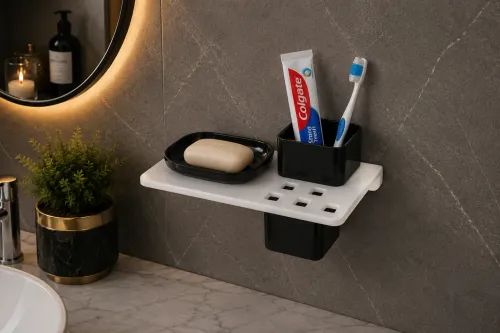
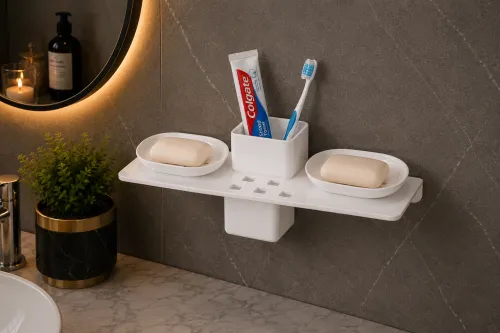
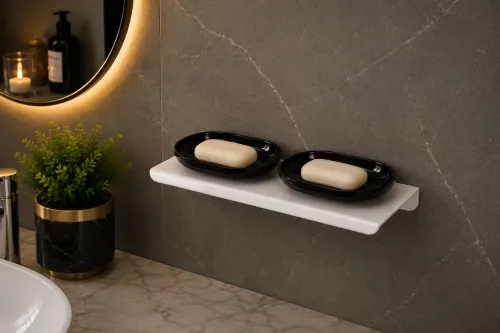
| Soap and solid cleanser | Front or separate upper shelf | A soap dish with drainage prevents a wet bar sitting in residue |
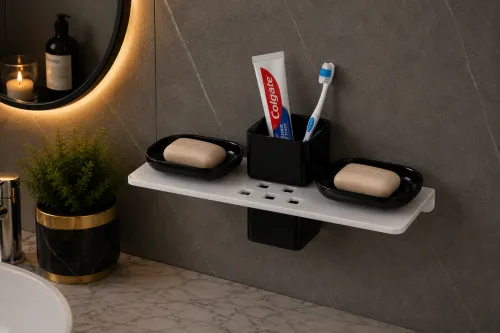
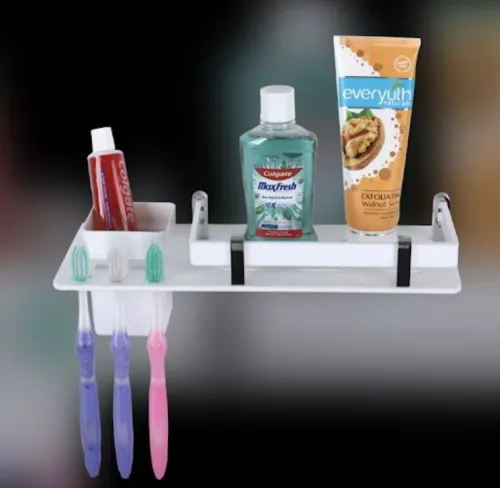
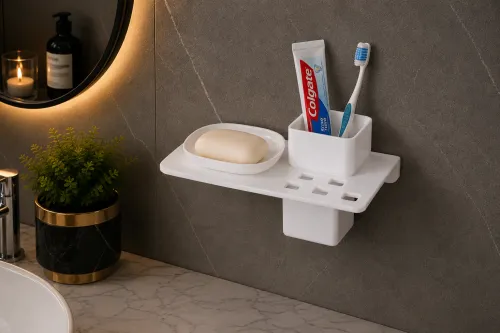
| Toothbrushes and razors shelf arrangement | Upright at the front or in a holder | Keep brush heads separated; use openings small enough to retain razor handles |
| Skincare jars and shaving supplies | Front-middle by height | Put short jars in front of tall bottles; keep shaving cream away from dripping products |
| Small cleaning items | Lowest shelf, away from personal items | Store sponges or travel cleaners in a defined corner, not across the drainage path |
Drainage grooves or holes matter for soap storage and wet bottles only when water can travel toward them and containers do not cover the openings. Choose openings that retain razors and travel-size containers.
A taller retaining lip stops pump bottles sliding off, but blocks short jars and traps residue; a low continuous lip or localized bottle stop is easier to clean for mixed toiletries. Leak-prone containers still need a surface you can wipe and space beneath.
Measure the Corner Before You Choose Shelf Dimensions
Measure bathroom corner shelf dimensions at the installed height, not from a catalogue photograph. Record the wall-to-wall distance, usable shelf depth at the center and both ends, and vertical clearance between shelves. Mark tile grout lines, silicone beads, rounded tile edges, and any uneven or out-of-square section that could make the shelf rock.
Trace every moving and reaching zone before choosing the footprint:
- Open the shower door, bathroom door, cabinet doors, and drawers fully; note where the shelf would enter each swing path.
- Mark the positions of taps, shower controls and door swing, handheld shower heads, mirrors, and towel rails.
- Stand in the space and mark where your shoulders and elbows travel while washing, shaving, or reaching for a bottle.
An advertised width or radius is not usable storage. The wall junction, mounting hardware, front retaining lip, and curved bottle radii all reduce the platform.
| Advertised measurement | Usable measurement to request | Why it matters |
|---|---|---|
| Overall width or radius | Depth at both ends and the center | Reveals the actual bottle platform |
| Nominal 90-degree rear corner | Rear-corner clearance and corner profile | Prevents rocking against rounded or uneven tile |
| Fixed mounting position | Shim or adjustment provision | Allows fitting in an out-of-square corner |
| Shelf depth | Depth after the lip and hardware | Shows whether containers will stand securely |
Request a dimensioned drawing with these figures before buying. “Shelf depth and clearance” without measurement points is not enough; a shelf that fits the walls can still block fittings or leave only one contact point.
Choose the Right Bathroom Location and Compare Storage Capacity
The best corner is the one that matches wetness, reach, and daily use. Install a shower corner shelf for shampoo and body wash, beside a bathtub for bathing products, near a vanity for skincare and grooming items, above a toilet for spare supplies, or in a dry corner for backup toiletries.
A corner shelf saves wall length but offers less continuous surface than a straight shelf. Count the containers you need to reach without moving others; a compact shower corner shelf suits a few daily bottles, while a larger collection may need another storage type.
| Option | Access and capacity | Limitation |
|---|---|---|
| Corner shelf | Uses an otherwise wasted corner; good for a small group of bottles | Less continuous surface and reduced access at the rear |
| Straight wall shelf | Provides the longest usable platform for many containers | Uses valuable wall length and can obstruct movement |
| Shower caddy | Often holds more bottles in a wet area | Can swing, sag, rust, or obstruct shower fittings |
| Recessed niche | Keeps storage flush with the wall; strongest recessed niche comparison | Requires construction, waterproofing, and permission to alter the wall |
| Freestanding rack | Offers several shelves and high capacity | Consumes floor area and can crowd a compact bathroom |
| Over-door organizer | Adds vertical storage without wall drilling | Reduces door clearance and can interfere with handles |
Choose the corner shelf when the items are few, the reach is clear, and installation permission is limited. Choose bathtub storage or a vanity organizer when access matters more than saving wall length; choose a rack or over-door system when container count exceeds the corner’s usable platform.
Specify Drainage, Fixings, and Cleaning for Reliable Use
Acrylic shelf drainage works only when the platform has a slight slope toward its outlet. Keep holes or slots clear of bottles: oversized openings can drop razors, caps, and travel containers, while tiny openings trap hair and soap film.
Leave enough space below the shelf to wipe residue, and inspect joints, sealant, and wall fixings for mould and soap residue or biofilm.
Before loading an adhesive mounting bathroom shelf, confirm that the surface is clean, dry, smooth, non-porous, and fully cured. Textured tile, wet grout, silicone contamination, dusty stone, and moving joints are poor bonding conditions. Follow the stated dwell or cure time; loading early can pull the pad away even when the shelf itself is strong.
For drilled installation, ask exactly what the fastener engages. Grout alone is not structural support.
- Confirm that the anchor reaches a stud, masonry, suitable backer, or specified plug behind the tile.
- Require a load rating that names the substrate, attachment method, front-edge loading position, test duration, and safety factor.
- Choose openings that retain razors and small containers without creating a cleaning trap.
- Rinse acrylic with water after cleaning, then use dilute neutral detergent and a soft, non-abrasive cloth.
- Avoid ammonia, ketones, aromatic solvents, alcohol-rich products, and abrasive powders; these can cause scratching, crazing, or stress cracking.
- Dry persistent wet areas and check adhesive edges, sealant lines, and tile anchors and wall fixings during routine cleaning.
Judge Acrylic Against Glass, Metal, and Plastic Before Buying
An acrylic versus stainless steel shelf decision comes down to weight, stiffness, cleaning exposure, and visibility—not appearance alone. PMMA weighs about 1.17–1.20 g/cm³, while austenitic stainless steel weighs roughly 7.9–8.0 g/cm³, making acrylic easier for adhesive or suction mounting. It needs adequate thickness or ribs to prevent flexing.
| Option | Strength | Main risk or limitation |
|---|---|---|
| Acrylic | Light, transparent, and resistant to metallic corrosion | Scratches, stains, crazing, stress-cracking, or flexing |
| Stainless steel | Stiff and impact-resistant | Chloride residue, bleach, trapped liquid, poor welds, or unsuitable grade can cause staining or localized corrosion |
| Glass | Rigid and visually clear | Heavy and breakable |
| Ceramic | Easy to clean | Heavy and brittle |
| Ordinary plastic | Lower purchase cost | Flexing and discoloration |
For clear or frosted acrylic, choose visibility for the user and the wall behind it. Clear material can disappear against white tile or glare; frosting, a contrasting edge, or a visible retaining lip helps users with reduced vision.
A tall lip prevents bottles sliding but blocks short containers and traps residue, so mixed toiletries suit a low continuous lip or localized bottle stop.
Ask the supplier for:
- PMMA bathroom shelf durability details, including thickness, ribs, edge finish, joints, and protective-film removal instructions.
- Shelf load rating specifications stating the substrate, fixing method, front-edge load position, test duration, and safety factor.
- For stainless steel, the grade, finish, weld quality, and post-fabrication cleaning method.
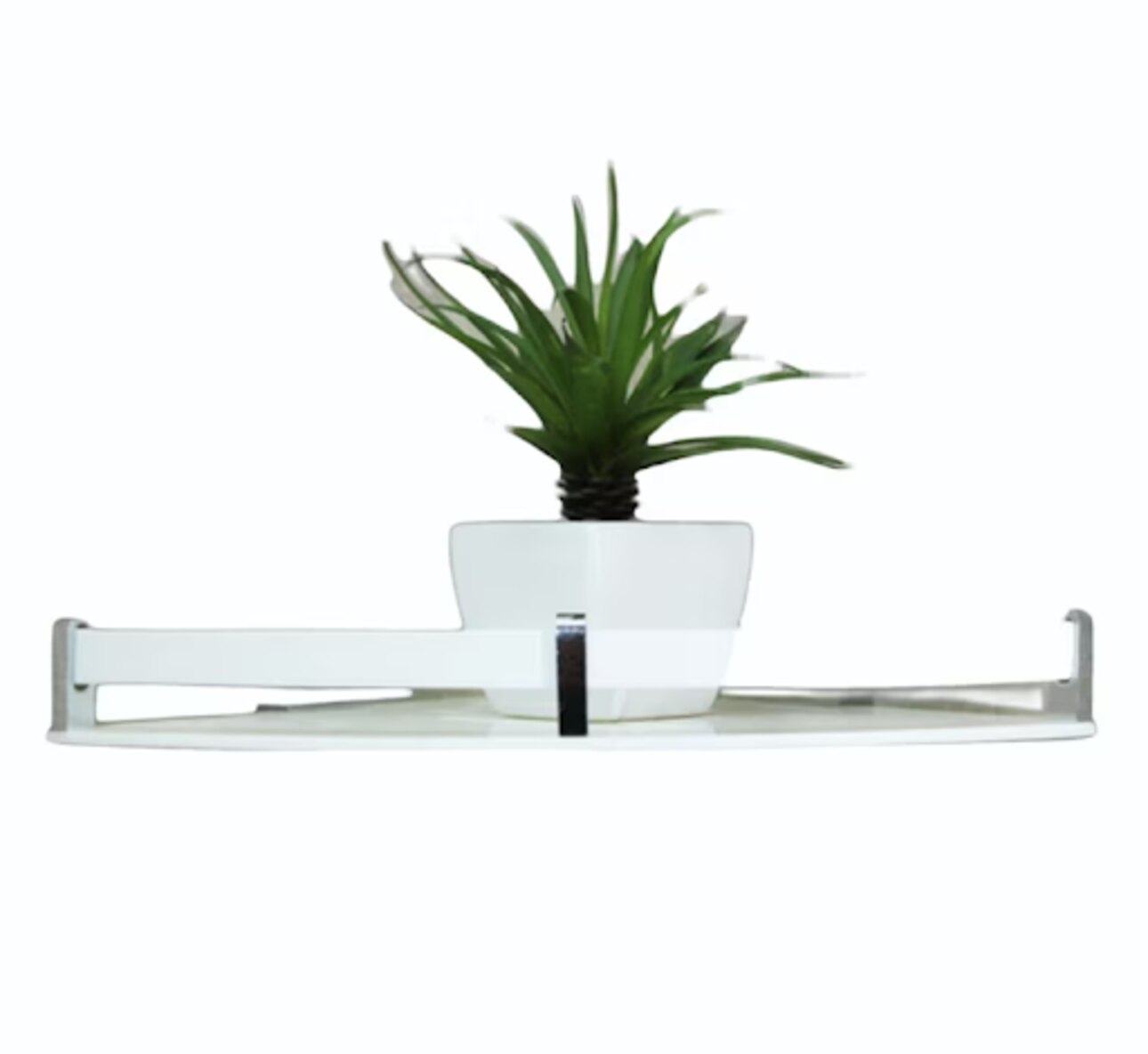
HV Enterprise is worth evaluating only when these documents and installation instructions accompany the shelf, rather than judging the product photograph. Avoid ammonia, ketones, aromatic solvents, alcohol-rich cleaners, and abrasive powders on acrylic.
Frequently asked questions
How should you match a corner shelf to your toiletries?
Place heavy, leak-prone containers low and near the wall, while keeping daily-use products at the front. Check the shelf depth against your largest bottle and the usable area against the number of items you store.
What measurements matter before buying a bathroom corner shelf?
Measure both walls from the corner, the available vertical height, and the maximum depth that will not obstruct movement or fixtures. Also allow room to lift bottles off the shelf.
Where should you install a bathroom corner shelf?
Choose a location within easy reach that does not interfere with the showerhead, taps, door swing, or cleaning access. Compare each position by usable shelf area and the number of bottles it can hold safely.
What drainage and fixing details should you specify?
Look for drainage holes or slots, smooth edges, corrosion-resistant screws or brackets, and fixings suited to the wall surface. Seal wall penetrations in wet areas to limit water ingress.
Is acrylic better than glass, metal, or plastic for a corner shelf?
Acrylic is lightweight, transparent, and less prone to shattering than glass, but it scratches more easily. Glass offers scratch resistance but adds weight, metal handles moisture well when corrosion-resistant, and plastic costs less but can flex or discolor.